

If you’ve been exploring synthesizers, you’ve probably come across terms like 2-OP, 4-OP, 6-OP and 8-OP FM synthesis.
But what exactly does OP mean? Why do some synthesizers have six operators while others have eight? And what do all six operators inside the M-VAVE FM-1 actually do?
To understand this, we first need to look at how FM synthesis works.
Unlike traditional subtractive synthesizers, which often start with a complex waveform and use filters to shape it, FM synthesis creates complex sounds by combining simple waveforms and using them to modulate each other.
This is what makes FM synthesis so interesting. Even though the individual sound sources are simple sine waves, combining them in different ways can produce everything from realistic electric pianos and bells to metallic percussion, deep basses and futuristic synthesizer sounds.
Let’s break it down.
1. What Is an Operator in FM Synthesis?
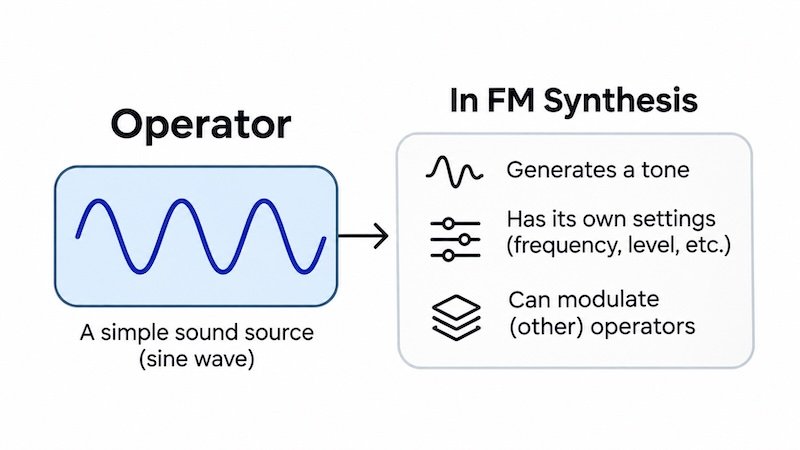 OP stands for Operator.
An operator is essentially an individual oscillator inside an FM synthesizer. In the M-VAVE FM-1, each operator generates a sine wave that can be used in two different ways:
- Carrier: An operator that produces the audible sound.
- Modulator: An operator that changes the frequency of another operator, creating additional harmonics and changing its tone.
Think of an operator as one building block of a sound.
On its own, a sine wave is very smooth and simple. It has a pure, clean tone without the complex harmonics found in instruments such as guitars, pianos or brass instruments.
But when you use one operator to modulate another, the result becomes much more interesting.
You can create brighter tones, metallic sounds, bells, electric pianos and many other textures.
The magic of FM synthesis comes from how these operators interact.
2. Carrier vs. Modulator: What Is the Difference?
 This is probably the most important concept to understand when learning FM synthesis.
Let’s imagine you have two operators:
- Operator 1 generates a sine wave.
- Operator 2 modulates Operator 1.
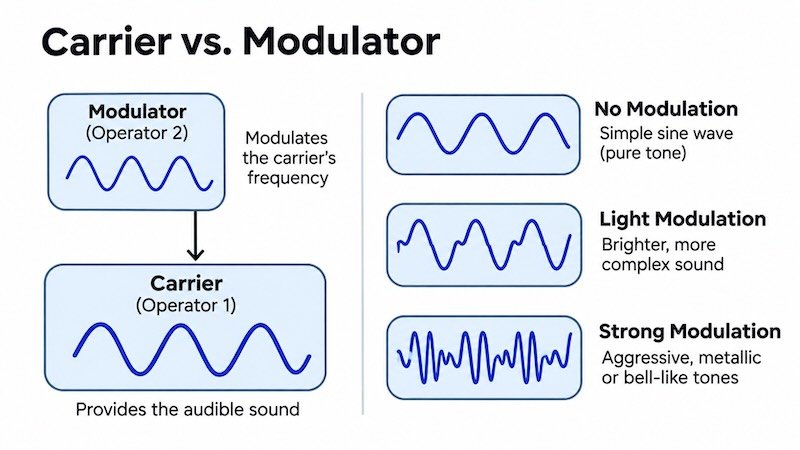
Operator 1 is the carrier, and Operator 2 is the modulator.
The carrier provides the audible sound, while the modulator changes its frequency at a very high speed.
This frequency modulation creates additional harmonics, changing the character of the original sine wave.
For example:
- A carrier without modulation produces a simple sine-wave tone.
- A small amount of modulation can create a brighter, more complex sound.
- Stronger modulation can produce aggressive, metallic or bell-like tones.
The important thing is that the modulator doesn’t simply add another sound on top of the carrier. It changes the carrier’s waveform by rapidly changing its frequency.
This is the foundation of FM synthesis.
3. What Happens When You Connect More Operators?
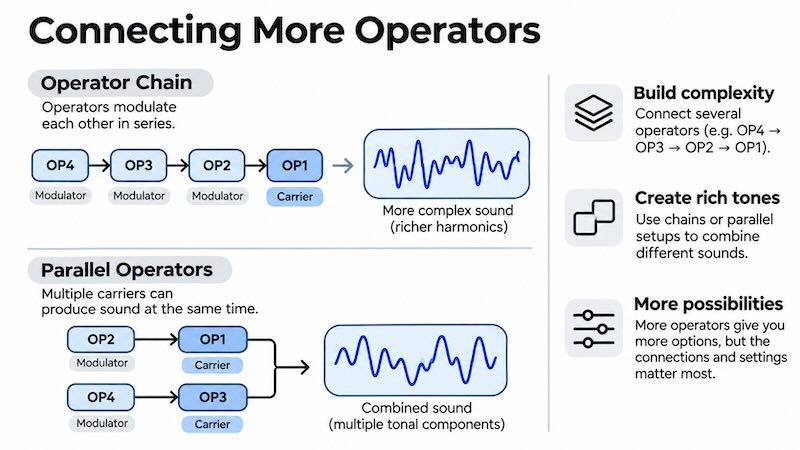
Now imagine adding more operators to the same sound.
Instead of having just one carrier and one modulator, you can connect several operators together.
For example:
- OP2 modulates OP1.
- OP3 modulates OP2.
- OP4 modulates OP3.
This creates a chain where each operator influences the next one.
The result is a much more complex sound.
You can also have multiple operators working in parallel, with several carriers producing sound at the same time.
This allows you to combine different tonal components into one instrument.
More operators mean more possibilities for building complex modulation structures, although more operators don’t automatically mean better sound.
How you connect and program them is just as important as how many you have.
4. What Does 6-OP Mean on the M-VAVE FM-1?
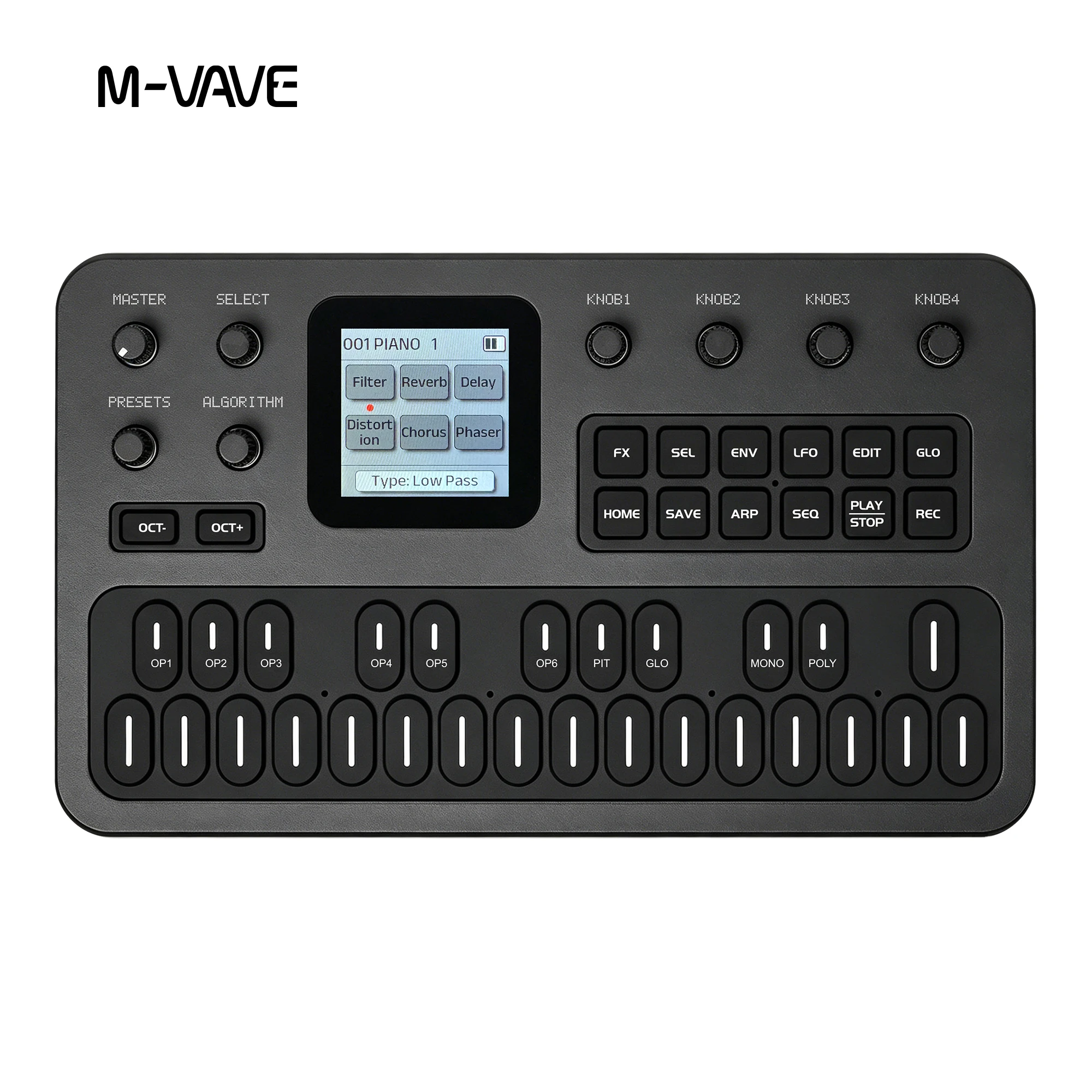
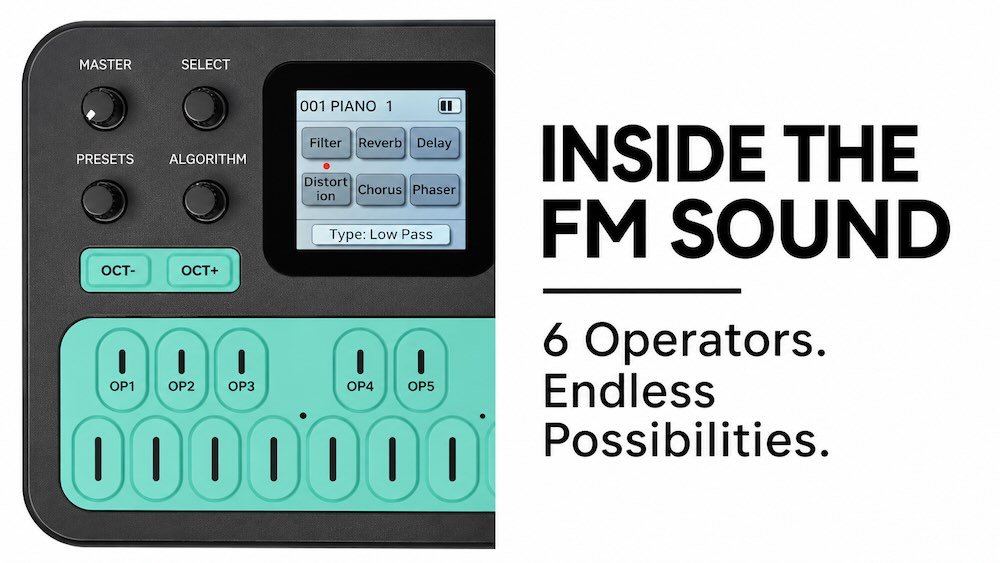
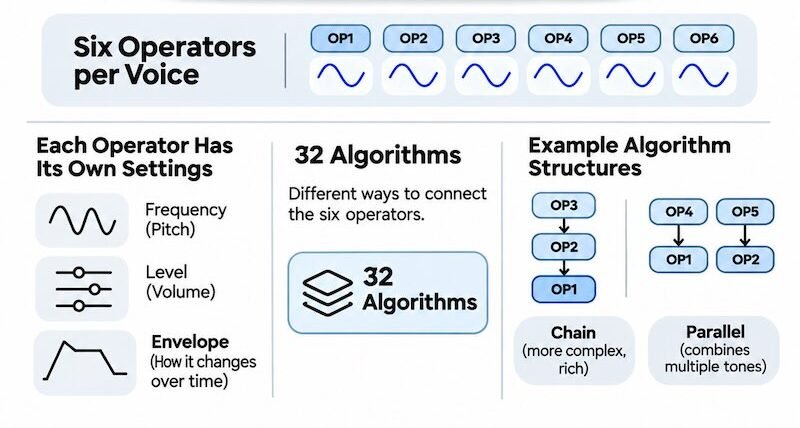 The M-VAVE FM-1 is a 6-operator FM synthesizer.
This means that each synthesizer voice has six independent sine-wave operators available for sound generation and modulation.
The six operators are labelled:
- OP1
- OP2
- OP3
- OP4
- OP5
- OP6
Each operator has its own settings and envelope, allowing you to control how it behaves over time.
You can adjust parameters such as its frequency, level and envelope characteristics.
The six operators can be connected in different configurations to create different sounds.
The FM-1 includes 32 algorithms, which determine how these six operators interact.
For example, one algorithm might connect several operators in a chain, while another might use multiple independent carriers with separate modulators.
This is why changing the algorithm can dramatically change the sound, even if you haven’t changed the individual operator settings.
Do the six operators represent six different instruments?
No. This is an important distinction.
The six operators aren’t six separate instruments or six notes.
They are six sound-generating components that work together to create a single synthesizer voice.
For example, when you press one key on the FM-1, its six operators can work together to create one complex sound.
When you play multiple notes in polyphonic mode, the synthesizer can use multiple voices, each with its own operator structure.
The FM-1 supports up to 12-note polyphony, so its six operators are not limited to producing just six notes.
5. What Are FM Algorithms?
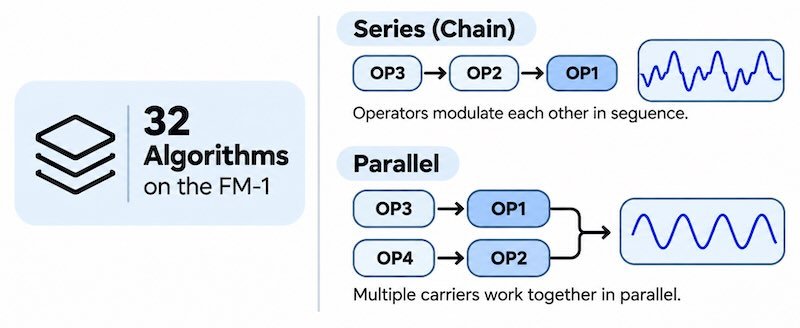 Now that we understand operators, the next question is: how do you connect them?
This is where algorithms come in.
An FM algorithm is simply a predefined connection pattern that determines how operators interact.
The M-VAVE FM-1 includes 32 different algorithms.
Each algorithm determines:
- Which operators act as carriers.
- Which operators act as modulators.
- How operators are connected.
- Whether operators work in series or parallel.
- Where feedback is applied.
Series connection
In a series arrangement, one operator modulates another, which then modulates another.
This creates increasingly complex modulation and can produce bright, metallic and harmonically rich sounds.
Parallel connection
In a parallel arrangement, multiple carriers generate audible sound simultaneously.
Each carrier can have its own modulation structure, allowing you to combine different tonal elements into one sound.
For example, one carrier could create the fundamental tone while another adds brightness or a bell-like character.
The different combinations are what make the 32 FM-1 algorithms so useful.
You can explore them by turning the ALGORITHM encoder on the FM-1. The screen displays a diagram showing how the operators are connected.
6. Why Do Some FM Synthesizers Have 4, 6 or 8 Operators?
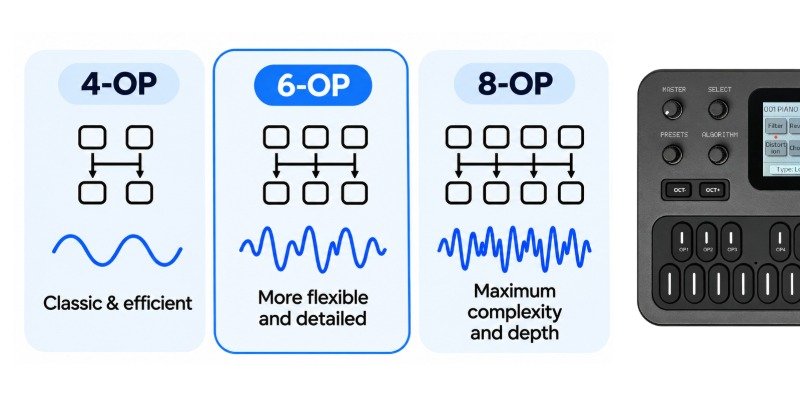 You might have noticed that different FM synthesizers advertise different numbers of operators.
Here is what the numbers mean:
| FM architecture | Operators | General characteristics |
|---|---|---|
| 2-OP | 2 | Simple FM sounds and basic modulation |
| 4-OP | 4 | More complex modulation and sound design |
| 6-OP | 6 | Richer modulation structures and more flexibility |
| 8-OP | 8 | More complex operator combinations and sound design possibilities |
A higher operator count gives you more building blocks to work with.
For example, a 2-operator synthesizer has fewer ways to combine carriers and modulators than a 6-operator synthesizer.
With eight operators, you can create even more elaborate modulation structures, including multiple carrier groups and longer modulation chains.
However, this doesn’t automatically make an 8-operator synthesizer sound better than a 6-operator one.
A well-programmed 2-operator sound can be excellent, and a 6-operator synthesizer can produce beautiful sounds without using all six operators at full capacity.
The sound itself depends on the algorithm, frequency ratios, modulation levels and envelopes.
7. What Can You Actually Do With the Six Operators on the FM-1?
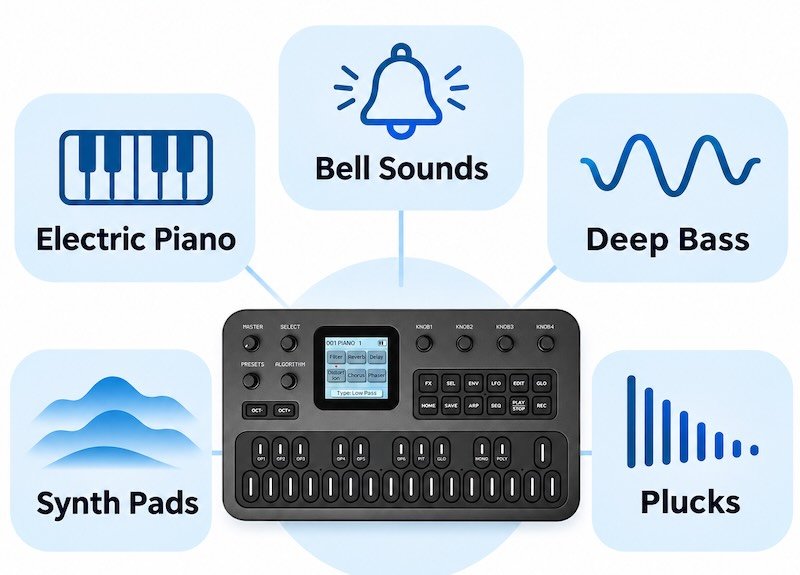 Understanding the theory is useful, but what does this mean when you’re making music?
Here are some examples of how FM operators can be used to create different sounds.
Electric piano
Use a carrier to generate the main note and a modulator to add the characteristic metallic attack of an FM electric piano.
The modulation envelope can decay quickly, creating a bright initial attack that becomes smoother as the note sustains.
Bell sounds
Use a higher-frequency modulation ratio to introduce inharmonic partials.
This creates the metallic, shimmering character associated with FM bells.
Deep bass
Use a relatively simple operator configuration and focus on the fundamental frequency.
You can experiment with additional modulation to introduce harmonics and give the bass more presence.
Synth pads
Use multiple carriers and carefully shaped envelopes to create layered tones.
Slower attacks and releases can make the sound evolve gradually, which is particularly useful for ambient and atmospheric music.
Plucks
Use a strong initial modulation amount with a quickly decaying envelope.
This creates a bright attack followed by a smoother tone, making it useful for short pluck sounds and melodic sequences.
These are starting points rather than fixed recipes. FM synthesis is all about experimentation.
8. How to Experiment With Operators on Your FM-1
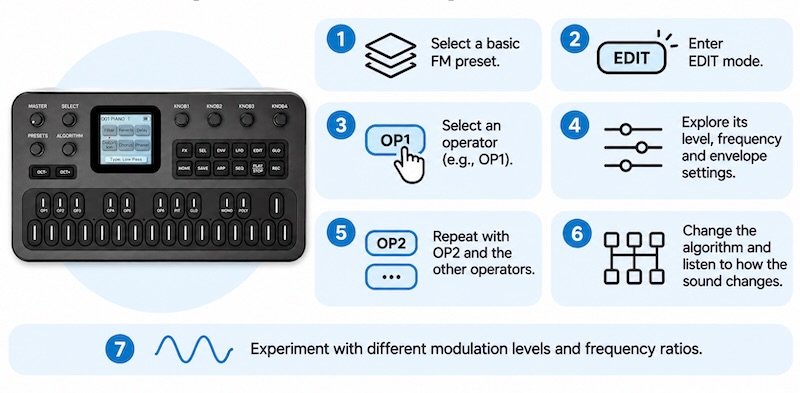 If you want to understand how the six operators work, the best way is to experiment with them directly.
Here is a simple exercise:
- Select a basic FM preset on your FM-1.
- Enter EDIT mode.
- Select an individual operator, such as OP1.
- Explore its level, frequency and envelope settings.
- Repeat with OP2 and the other operators.
- Change the algorithm and listen to how the sound changes.
- Experiment with different modulation levels and frequency ratios.
A useful tip is to change only one parameter at a time.
This makes it much easier to hear what each operator is doing.
Try comparing two algorithms while keeping the operator settings unchanged. You’ll quickly discover how much the operator connections influence the final sound.
FM-1 Available Now on Uniqtone!