

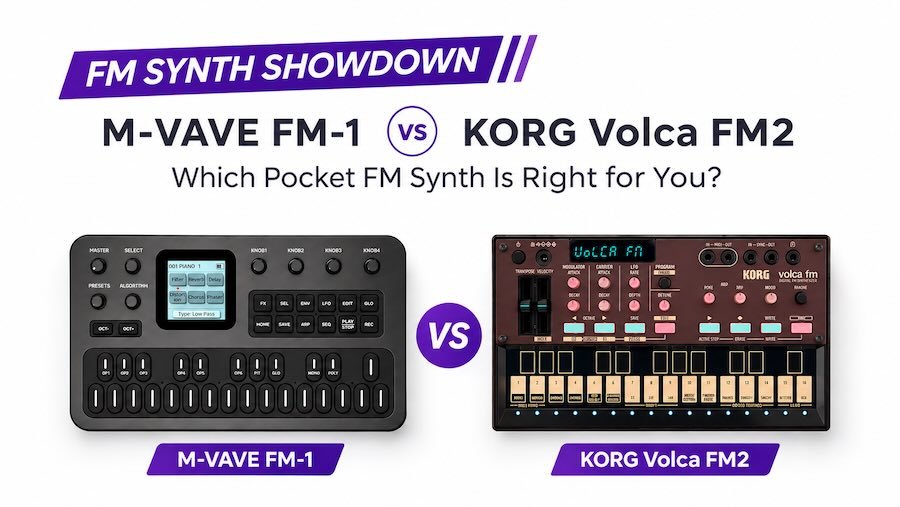
M-VAVE FM-1 vs KORG Volca FM2: Which Pocket FM Synth Should You Buy?
If you’re looking for a compact FM synthesizer that can produce everything from classic digital electric pianos to evolving synth textures, two interesting options are the M-VAVE FM-1 and the KORG Volca FM2.
Both instruments bring the unmistakable sound of classic six-operator FM synthesis into a portable format. Both support Yamaha DX7-style sounds, feature built-in sequencers and arpeggiators, and are designed for musicians who want to create music without relying entirely on a computer.
However, there are some important differences.
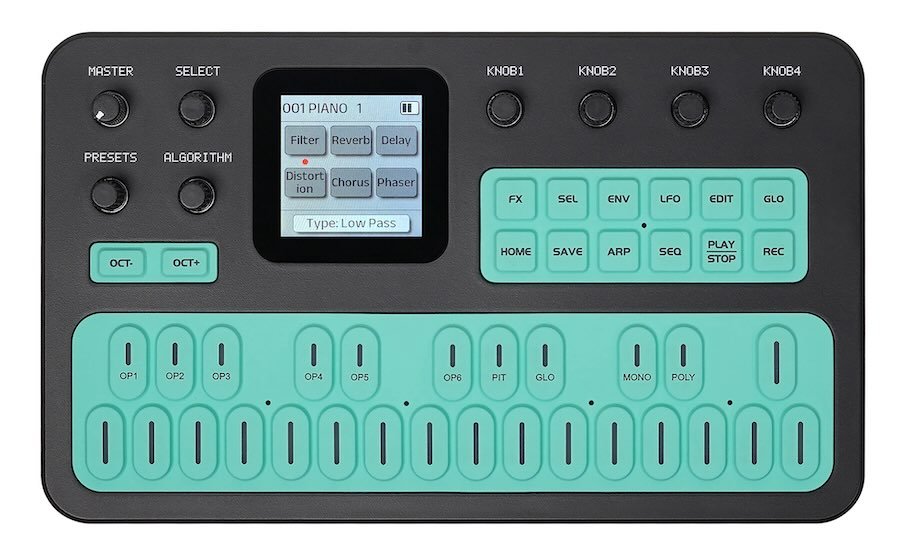
The M-VAVE FM-1 offers up to 12-voice polyphony, a rechargeable battery, USB-C audio and Bluetooth connectivity. The KORG Volca FM2 takes a different approach, combining a familiar Volca workflow with hands-on controls, MIDI connectivity and KORG’s established hardware ecosystem.
So, which one is the better pocket FM synthesizer?
Let’s compare them.
M-VAVE FM-1 vs KORG Volca FM2: Quick Comparison
| Feature | M-VAVE FM-1 | KORG Volca FM2 |
|---|---|---|
| Synthesis | 6-operator FM | 6-operator FM |
| Algorithms | 32 | 32 |
| Maximum polyphony | 12 voices | 6 voices |
| Factory presets | 128 | 64 |
| Keyboard | 27-key silicone keyboard | 27-key touch keyboard |
| Effects | Filter, reverb, delay, distortion, chorus, phaser | Chorus and reverb |
| Arpeggiator | 7 modes | 9 patterns |
| Sequencer | 16 steps | 16 steps |
| Battery | Rechargeable 2000mAh | 6 AA batteries |
| Battery life | Up to approximately 12 hours | Approximately 10 hours |
| USB-C | MIDI, charging and digital audio | No USB-C |
| Bluetooth MIDI | Yes | No |
| Audio output | 3.5mm | 3.5mm |
| Built-in speaker | Yes | Yes |
| DX7 patch compatibility | Yes, FM SysEx | Yes, with conversion/loading |
| Weight | Approximately 251g | Approximately 360g without batteries |
Specifications are based on manufacturer information and published product testing. Battery life is approximate and depends on usage.
1. FM Synthesis: Both Have Six Operators and 32 Algorithms
Let’s start with the most important part: the sound engine.
Both synthesizers use six-operator FM synthesis with 32 algorithms.
This is significant because the six-operator architecture is associated with classic instruments such as the Yamaha DX7, one of the most influential digital synthesizers ever made.
But what exactly are operators?
In FM synthesis, operators are individual sound-generating components. Each operator produces a waveform, and operators can modulate one another to create complex harmonic structures.
Depending on how the operators are connected, you can produce very different sounds.
For example:
- Electric piano sounds with metallic attacks.
- Deep and punchy FM basses.
- Bell-like and glassy tones.
- Digital mallets and plucks.
- Complex evolving synth pads.
- Bright synth brass and strings.
The 32 algorithms determine how the six operators are connected.
Both the M-VAVE FM-1 and Volca FM2 provide access to this classic FM architecture, making them capable of producing a wide range of digital sounds.
Winner: Tie
Both offer the same fundamental six-operator, 32-algorithm architecture.
2. Polyphony: The FM-1 Has a Significant Advantage
One of the biggest differences between these two instruments is polyphony.
The M-VAVE FM-1 supports up to 12 simultaneous voices in poly mode, while the KORG Volca FM2 supports up to six voices.
Why does this matter?
Polyphony determines how many notes can sound simultaneously.
For example, when playing a piano-style chord, each note uses a voice. Higher polyphony gives you more room for complex chords and overlapping notes.
The FM-1’s 12-voice capacity makes it particularly interesting for:
- Richer electric piano chords.
- Layered-sounding pad parts.
- More complex chord progressions.
- Playing longer notes while other notes continue.
The Volca FM2’s six voices are still sufficient for many melodic and sequenced parts, but the FM-1 has more headroom for polyphonic playing.
Winner: M-VAVE FM-1
3. Effects and Sound Design
Effects are another area where the two instruments differ.
The M-VAVE FM-1 includes six built-in effects:
- Filter
- Reverb
- Delay
- Distortion
- Chorus
- Phaser
These effects provide additional ways to shape the sound without connecting external equipment.
For bedroom producers, this is particularly useful. You can create a sound, add some movement or atmosphere, and record it directly into your DAW.
The Volca FM2 has built-in chorus and reverb.
These are useful effects, particularly for adding width and space to traditional FM sounds. However, the FM-1 offers a wider selection of onboard processing options.
One important consideration is that more effects do not automatically mean better sound quality. Both instruments have their own sonic character, and you may prefer processing either one externally.
Winner: M-VAVE FM-1 for onboard effect variety.
4. Connectivity: USB-C and Bluetooth vs Traditional Hardware Connections
This is probably one of the most important differences for modern music producers.
The M-VAVE FM-1 offers:
- USB-C MIDI
- USB-C digital audio
- Bluetooth MIDI
- Bluetooth audio
- 3.5mm audio output
- 3.5mm MIDI input
Its USB-C connection can be particularly useful when working with a computer, tablet or smartphone.
Published testing has also confirmed USB audio functionality, allowing digital audio transfer to compatible devices without relying exclusively on the analog headphone output.
This makes the FM-1 interesting for portable music production setups.
The KORG Volca FM2 uses a more traditional hardware approach.
It offers MIDI IN and OUT through 3.5mm connections, along with a headphone output and KORG Sync connections for connecting other Volca instruments.
It does not offer USB-C audio or Bluetooth MIDI.
If you primarily work inside Logic Pro, Ableton Live, GarageBand or another DAW, the FM-1’s USB connectivity is a major convenience.
Winner: M-VAVE FM-1
5. Free Software, Custom Firmware and the FM-1 Community
Perhaps one of the most interesting things about the M-VAVE FM-1 isn’t even the hardware itself. It’s the growing community of developers creating free software, alternative firmware and tools that significantly expand what this little synthesizer can do.
The original FM-1 is already a capable six-operator FM synthesizer, but community-developed projects can turn it into something quite different.
This is a major advantage for musicians who enjoy experimenting with new workflows and exploring different types of music production.
SLOOP: Turn Your FM-1 into a Groovebox
One of the most interesting community projects is SLOOP, a free and open-source firmware developed for the M-VAVE FM-1.
Rather than simply functioning as a traditional synthesizer, SLOOP transforms the FM-1 into a compact four-track groovebox.
It includes:
- Three synthesizer tracks and one drum track.
- Multiple synthesis engines, including six-operator FM.
- DX7-compatible sound support.
- Built-in drum machines and drum kits.
- User sample support.
- Step sequencing and live recording.
- Parameter locks, fills and rhythmic effects.
- Performance-oriented effects and sound manipulation.
This opens up possibilities for creating complete musical ideas directly on the FM-1, without necessarily connecting a computer or using a separate drum machine.
For beatmakers and electronic musicians, this is a particularly exciting development.
SLOOP is free and open-source, and its development is driven by the FM-1 community.
Explore: https://github.com/isod89/sloop-fm1
Felucca: A Multi-Engine Synthesizer and Sequencer
Another interesting project is Felucca, which provides a multi-engine synthesizer and sequencing environment.
It takes the FM-1 beyond its original FM synthesis architecture, offering additional sound engines and more advanced sequencing possibilities.
Depending on the firmware version, features include:
- Multiple synthesis engines.
- Four-track sequencing.
- Sound design and parameter editing.
- Automation and modulation.
- Pattern-based music creation.
- A browser-based editor.
Felucca is particularly interesting if you enjoy experimenting with different types of synthesis rather than sticking exclusively to classic FM sounds.
Explore: https://github.com/hugofvg/Felucca
Baud Girl: FM and Virtual Analog Synthesis
Another project worth exploring is Baud Girl FM-1+VA.
This alternative firmware combines the original FM sound engine with an additional virtual analog synthesizer engine.
The result is an interesting combination of classic digital FM sounds and more traditional synthesizer-style tones.
It is particularly appealing if you want to experiment with different types of sounds from one compact instrument.
More Community Projects
The FM-1 community continues to develop new ideas, tools and alternative firmware.
Other projects include:
- X0X: A groovebox inspired by classic 808, 909 and 303-style instruments.
- OberVave: An Oberheim-inspired virtual analog synthesizer.
- FoMni: An Omnichord-inspired instrument for playing chords and strummed sounds.
- sloopDX: A DX7-focused synthesizer and drum machine based on SLOOP.
- FM1 Open: M-VAVE’s own open-firmware project, providing an SDK and additional development possibilities.
You can explore the growing collection through the FM-1 community firmware directory:
What About the KORG Volca FM2 Software?
The KORG Volca FM2 also has useful software support.
For example, KORG provides access to Synthmata, a free online editor developed in collaboration with Oscillator Sink. It allows users to edit and manage FM patches through a browser.
KORG also offers a software bundle with selected music production applications.
However, the FM-1’s growing custom-firmware ecosystem is particularly interesting because developers are extending the instrument beyond its original purpose as a conventional FM synthesizer.
This is an important distinction: both instruments benefit from software tools, but the FM-1 community is exploring much deeper changes to the instrument itself.
Winner: M-VAVE FM-1 for custom firmware and community experimentation.
6. Portability and Battery Life
Both instruments are portable, but they approach power differently.
The M-VAVE FM-1 has a built-in rechargeable 2000mAh battery with approximately 12 hours of advertised battery life.
It also includes a small built-in speaker, allowing you to experiment with sounds without immediately connecting headphones or external speakers.
The KORG Volca FM2 uses six AA batteries and offers approximately 10 hours of battery life.
It also has a compact design, although it is slightly larger and heavier.
For travelling musicians and producers who want to create music anywhere, the FM-1’s rechargeable battery and built-in speaker make it especially convenient.
Winner: M-VAVE FM-1
7. Sound Banks and Yamaha DX7 Compatibility
Both synthesizers can work with classic Yamaha DX7-style sounds.
This is one of the most attractive aspects of six-operator FM synthesis.
There are thousands of classic FM patches available online, including electric pianos, basses, bells, synth leads and atmospheric sounds.
The M-VAVE FM-1 supports compatible FM SysEx sound banks. This opens up a large collection of sounds originally created for DX7-compatible FM synthesizers.
The KORG Volca FM2 also supports loading converted Yamaha DX7 SysEx files.
However, patch compatibility does not necessarily mean every patch will sound exactly the same. Differences in implementation, effects, parameter handling and velocity response can affect the final result.
If you enjoy exploring old sound libraries and experimenting with different presets, both instruments offer plenty of possibilities.
Winner: Tie
8. Which Synth Is Better for Bedroom Producers?
This is where the intended use becomes important.
If you’re producing lo-fi, hip-hop, ambient, electronic music or modern pop, the FM-1 offers an interesting combination of features.
You can use it for:
- FM electric piano chords.
- Vintage digital bass sounds.
- Lo-fi melodies.
- Ambient textures.
- Synthwave-style leads.
- Short plucks and arpeggios.
The USB-C audio connection also makes it convenient to record sounds directly into a computer or compatible mobile device.
The Volca FM2 is also a capable production instrument, particularly if you enjoy working with physical hardware, sequencing patterns and connecting multiple Volca instruments.
Its dedicated Volca workflow may appeal to musicians who prefer a more traditional hardware setup.
9. Price and Overall Value
Price is another important consideration.
The M-VAVE FM-1 is generally positioned in the affordable pocket-synth category. Its price can vary depending on the retailer, region and promotions.
The KORG Volca FM2 is a more established product from a major synthesizer manufacturer and generally sits at a higher price point.
Check current retailer pricing before purchasing, as prices can change.
When comparing value, consider what is included rather than looking only at the initial purchase price.
The FM-1 offers more polyphony, more onboard effects, rechargeable power, Bluetooth and USB-C audio.
The Volca FM2 offers KORG’s established hardware design, a familiar Volca workflow and a more traditional instrument experience.
Final Verdict: Should You Buy the M-VAVE FM-1 or KORG Volca FM2?
Both instruments offer a compact way to explore six-operator FM synthesis, but they are designed with slightly different priorities.
Choose the M-VAVE FM-1 if you want:
- Up to 12-voice polyphony.
- USB-C audio recording.
- Bluetooth MIDI connectivity.
- A rechargeable battery.
- A built-in speaker.
- More onboard effects.
- An affordable portable synth for music production.
Choose the KORG Volca FM2 if you want:
- A familiar KORG Volca workflow.
- Physical hardware controls.
- Traditional MIDI and Volca Sync connections.
- A dedicated compact instrument for sequencing and performing.
- An established hardware platform.
Our Pick
For modern bedroom producers, travelling musicians and anyone looking for an affordable FM synthesizer that integrates easily into a computer-based music production setup, the M-VAVE FM-1 is a very compelling option.
Its 12-voice polyphony, USB-C audio, rechargeable battery and six onboard effects make it particularly versatile for its size and price.
The KORG Volca FM2 remains a good alternative, especially if you prefer the Volca ecosystem.
Ultimately, both instruments offer a lot of creative potential, but the FM-1 provides more connectivity and features for producers who want a compact instrument that fits into a modern production workflow.
Explore the M-VAVE FM-1 at Uniqtone
Looking for a compact FM synthesizer for your home studio or portable music production setup?
Explore the M-VAVE FM-1 at Uniqtone and discover the possibilities of six-operator FM synthesis.
Click here to view the M-VAVE FM-1 at Uniqtone