


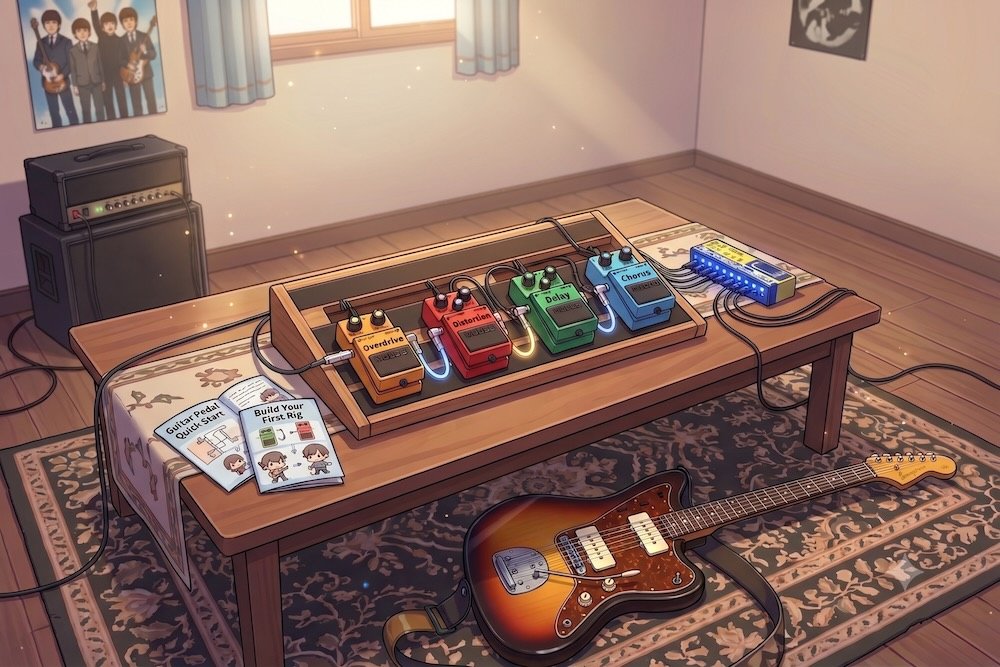
The best guitar pedals for beginners are usually a tuner, overdrive, distortion, delay, or chorus pedal depending on the player’s style. For young or first-time players, simple controls, durable construction, and affordable pricing matter more than advanced digital features. Selecting a combination of utility and creative effects allows new guitarists to explore different musical genres while building fundamental skills in tone management.
At Uniqtone, we focus on helping beginners build their first creative pedalboard setups without overwhelming them with overly complex gear.
Who This Guide Is For
-
First-time electric guitar players looking to expand their sonic palette beyond their amplifier’s built-in sound.
-
Hobbyists and bedroom musicians moving from digital software plugins to tangible hardware setups.
-
Parents looking for reliable, durable, and budget-friendly effect options for younger students.
What are the best guitar pedals for beginner guitarists?
When starting out, you do not need an entire multi-effects processor. Focus on the “Core Four” categories to establish your foundational tone:
-
Utility (The Tuner): A pedalboard tuner mutes your signal and ensures perfect pitch accuracy. It is the single most critical, unglamorous tool you will own.
-
Gain (Overdrive or Distortion): Overdrive mimics a tube amplifier breaking up naturally, perfect for blues and rock. Distortion clips the signal harder, providing heavy, aggressive tones ideal for hard rock and metal.
-
Modulation (Chorus): Chorus splits your guitar signal, detunes one part slightly, and delays it to create a lush, shimmering, and spacious “thickened” sound.
-
Time-Based (Delay): Delay records your playing and plays it back a split-second later, creating distinct echoes that add depth and dimension to your solos and ambient riffs.
My First Pedalboard: Beginner Comparison Matrix
| Core Need | Recommended Pedal Type | Why It Matters for Beginners | Primary Sonic Effect |
|---|---|---|---|
| Flawless Tuning & Muting | Tuner Pedal | Acts as a master mute switch and ensures you are perfectly in tune, even in loud environments. | None (Silent Utility) |
| Rock & Blues Crunch | Overdrive Pedal | Mimics a tube amplifier breaking up naturally; highly responsive to how hard you pick. | Warm, gritty saturation |
| Heavy Rock & Metal | Distortion Pedal | Aggressively clips your signal to provide tight, heavy tones ideal for modern rock and metal. | High-gain, aggressive sustain |
| Liquid Depth & Texture | Chorus Pedal | Splits and subtly detunes your signal to create a lush, shimmering, and thickened sound. | Shimmering, watery modulation |
| Spacious Echoes & Ambient Trails | Delay Pedal | Records your playing and plays it back a split-second later to add massive depth and space. | Rhythmic echoes and ambient wash |
Are mini pedals good for first-time players?
Yes, mini pedals are excellent choices for beginner guitarists. Because mini pedals feature a footprint that is roughly 50% smaller than standard enclosures, they allow you to experiment with more effects without needing a heavy, expensive, or oversized pedalboard layout.
However, beginners should keep two minor trade-offs in mind:
-
Power Requirements: Due to their small size, mini pedals cannot house a 9V internal battery. You will need a standard external 9V power supply or a dedicated power brick to run them.
-
Control Knobs: The control layout on a mini pedal is compact. If you have large hands or plan to tweak settings frequently mid-song during a live performance, a standard-sized pedal might feel more comfortable.
Common Beginner Buying Mistakes to Avoid
-
Buying complex, menu-heavy pedals: If a pedal requires you to scroll through a tiny LCD screen just to change the volume, it will distract you from actually practicing your guitar. Stick to simple knobs.
-
Ignoring the power supply: Daisy-chaining too many high-draw pedals into a cheap wall adapter creates harsh background hiss and hum. Budget for a clean power source from day one.
-
Skipping the tuner: Relying on a clip-on headstock tuner during a loud jam session or a live open-mic night is unreliable. A dedicated pedal tuner acts as an essential master-mute switch for your entire rig.
Frequently Asked Questions
What order should I plug my pedals into?
As a general rule for beginners, connect your guitar to the Tuner first, followed by the Overdrive/Distortion, then Chorus, and finally Delay leading into the amplifier. This setup keeps your foundational tone clean and articulate.
Do I need a pedalboard right away?
No. If you only own two or three pedals, you can easily place them on the floor and link them with short patch cables. Upgrade to a physical board once you need to transport your gear frequently.
Can I use these pedals with any amplifier?
Yes, virtually all standard guitar pedals utilize universal $1/4\text{-inch}$ instrument jacks and will work with any traditional solid-state or tube guitar amplifier.
Related Guides and Collections
-
Explore Our Curated Gear: [Shop the Beginner Pedal Collection]
-
Next Level Setup: [How to Build a Mini Pedalboard in Small Spaces]
-
Deep Dive: [How to Choose Delay and Chorus Pedals for Ambient Guitar]

