


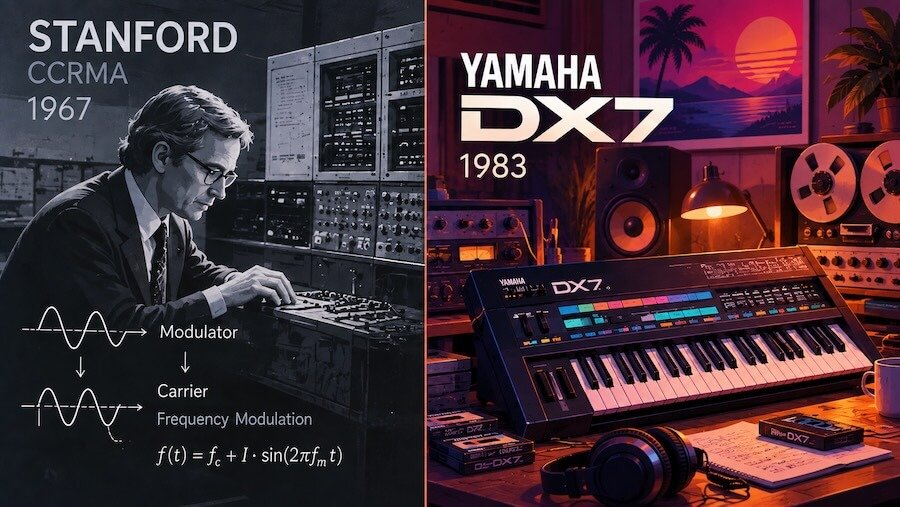
Few sound engines in music production history have altered the sonic landscape as dramatically as Frequency Modulation (FM) synthesis. From the glassy digital electric pianos of 80s pop ballads to the metallic, cutting basslines of synthwave, cyberpunk, and lo-fi, FM synths have defined decades of hit records.
Yet, before it powered world-touring rigs and plugin folders, FM synthesis was born from an accidental discovery inside an academic lab. Here is the true origin story of FM synthesis—and how it evolved from complex mainframe mathematics into the portable, screen-free modules powering modern producers on the move.
1. The Accidental Invention: John Chowning at Stanford (1967)
In the late 1960s, Dr. John Chowning was working at Stanford University’s Center for Computer Research in Music and Acoustics (CCRMA). He wasn’t explicitly trying to create a revolutionary commercial synth engine; he was researching pitch perception and extreme vibrato using mainframe computers.
While experimenting, Chowning pushed the frequency rate of an LFO (Low-Frequency Oscillator) modulating an audio pitch into the audible range—exceeding $20\text{ Hz}$. Instead of hearing a simple fast pitch wobble, the sound transformed into a completely new, harmonically rich timbre.
Chowning realized that by using one sine wave (the modulator) to rapidly alter the frequency of another sine wave (the carrier), he could create complex sideband frequencies. With just two digital oscillators, he could emulate complex acoustic resonances like brass instruments, struck metals, and shimmering bells—sounds traditional analog subtractive synthesis heavily struggled to replicate.
2. The Commercial Breakthrough & Legendary Hits
Stanford attempted to license Chowning’s FM patent to American organ and synthesizer companies, but manufacturers initially turned it down, viewing digital synthesis as too complex.
Enter Yamaha. Recognizing the potential of Chowning’s research, Yamaha licensed the technology in the 1970s and spent years refining the hardware. In 1983, they released the Yamaha DX7—and changed music history overnight. It offered 16-note polyphony and 6 digital operators routed through 32 algorithms, quickly dominating 1980s music production.
Iconic Songs & Artists Powered by FM Synthesis
The glassy, cutting character of FM synthesis shaped the signature sound of global chart-toppers:
-
Michael Jackson – “Take Me Heaven” / “Bad” Album: Legendary keyboardist Greg Phillinganes used the DX7 extensively across Michael Jackson’s 80s records, defining the crisp electric piano tone of the era.
-
A-ha – “Take On Me” (1985): The iconic driving synth lead line was crafted using a combination of digital FM synthesis and analog layers.
-
Kenny Loggins – “Danger Zone” (1986): The punchy, metallic bassline driving this Top Gun anthem is a classic example of DX7 FM bass patches.
-
Whitney Houston – “Greatest Love of All”: The pristine, shimmering digital Rhodes sound (E. PIANO 1) became the gold standard for power ballads throughout the late 80s.
-
Sega Genesis / Mega Drive Video Game Soundtracks: Games like Sonic the Hedgehog and Streets of Rage relied on Yamaha YM2612 FM sound chips, cementing FM synthesis as the soundtrack of 16-bit gaming culture.
However, early FM hardware brought a famous downside: brutal menu-diving. Programming custom patches required navigating tiny LCD screens and calculating ratio parameters, causing many artists to stick strictly to factory presets.
3. The DAW Era: Software VSTs and Screen Fatigue
By the late 1990s and 2000s, processing power allowed FM synthesis to migrate inside Digital Audio Workstations. Plugins like Native Instruments’ FM8 brought visual routing grids and drag-and-drop envelopes to laptop producers.
While VST plugins solved the menu-diving problem of the 80s, they introduced a modern challenge: screen fatigue. Spending hours clicking virtual knobs on a computer monitor often drained the spontaneous, tactile joy out of sound design.
4. The Portable Evolution: FM Synthesis on the Go
Modern music creators are no longer bound to rigid desktop studios or heavy 80s hardware units. Today’s producers demand tactile, hands-on sound design that fits straight into a travel bag alongside a laptop and controller.
[ Stanford CCRMA Labs (1967) ] ──> [ Yamaha DX7 (1983) ] ──> [ DAW VST Plugins ] ──> [ Modern Portable FM Modules ]
    (Accidental Discovery)             (Heavy & Complex)          (Screen Fatigue)        (Tactile, Portable & Mobile)
By taking FM synthesis away from computer screens and heavy flight cases, producers can step into cafes, park benches, or hotel rooms and sketch metallic basslines, warm lo-fi leads, and ambient textures by ear.
For creators building a mobile setup, compact hardware modules like the M-VAVE FM-1 bring this legendary, bell-like digital sound engine into an ultra-portable, wireless format—allowing you to capture classic 80s FM character wherever inspiration strikes.

