


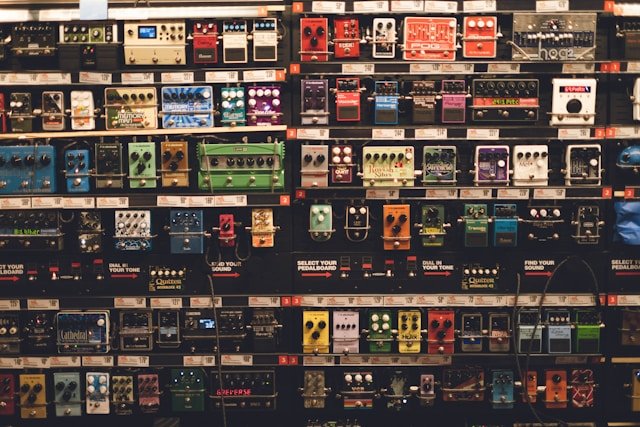
Buying your first guitar pedal should be exciting. Instead, many beginner guitarists find themselves overwhelmed by endless YouTube reviews, conflicting advice, and hundreds of pedals that all seem to promise the “perfect tone.”
The good news is that choosing your first effects pedal doesn’t have to be complicated.
In this guide, we’ll explore why guitar pedals often feel so confusing and share practical tips to help you narrow your options with confidence.
1. There Are Too Many Types of Guitar Pedals
One of the biggest challenges is simply understanding what each pedal does.
Walk into a music store or browse online, and you’ll find dozens of categories:
- Overdrive
- Distortion
- Fuzz
- Chorus
- Phaser
- Flanger
- Delay
- Reverb
- Compressor
- EQ
- Tremolo
- Octave
- Wah
- Looper
For someone who has only played with a clean amp, it’s difficult to imagine how each effect changes your sound.
How to simplify it
Instead of learning every pedal at once, start with the four most common effect categories:
- Drive – Adds grit, warmth, or distortion.
- Modulation – Creates movement and texture.
- Delay – Repeats your notes.
- Reverb – Adds space and ambience.
These four categories cover the majority of sounds you’ll hear in popular music.
2. Every YouTube Demo Sounds Different
You watch one review and love a pedal. Then another guitarist demonstrates the same pedal, and it sounds completely different.
Why?
Because tone depends on much more than the pedal itself:
- Guitar pickups
- Amplifier
- Playing style
- Strings
- Recording equipment
- EQ settings
A pedal is only one piece of the signal chain.
How to simplify it
Listen for the character of the effect rather than trying to copy the exact tone. Ask yourself:
- Does this delay sound warm or bright?
- Is the chorus subtle or dramatic?
- Does the overdrive stay clear when chords are played?
These qualities will stay consistent even when the gear changes.
3. Expensive Doesn’t Always Mean Better
Many beginners assume that a $300 boutique pedal will automatically sound better than a $50 alternative.
In reality, many affordable pedals offer excellent sound quality, especially for players who are still discovering what styles they enjoy.
A less expensive pedal can often provide:
- Great sound
- Reliable performance
- A chance to explore new effects without a large investment
How to simplify it
Choose pedals that inspire you to play more, not the ones with the highest price tag.
4. Everyone Recommends Something Different
Ask ten guitarists which pedal to buy first, and you’ll probably get ten different answers.
That’s because every guitarist has different goals.
Someone playing blues might recommend an overdrive, while an ambient guitarist may insist on reverb or delay.
None of them are wrong—they simply have different musical priorities.
How to simplify it
Ask yourself:
- What songs do I enjoy playing?
- Which guitarists inspire me?
- What sound makes me smile when I play?
Your answers matter more than anyone else’s recommendations.
5. There Are Too Many Controls
Some pedals have only three knobs.
Others have twelve controls, hidden menus, and multiple operating modes.
For beginners, this can feel intimidating.
How to simplify it
Start with pedals that have straightforward controls, such as:
- Gain
- Tone
- Level
or
- Time
- Feedback
- Mix
Learning the basics first makes it much easier to understand more advanced pedals later.
6. Fear of Buying the Wrong Pedal
Many new players delay buying anything because they’re afraid of making a mistake.
The truth is, there is no single “correct” first pedal.
Most guitarists eventually try several effects before discovering the sounds they love.
Every pedal teaches you something about your playing and your musical preferences.
How to simplify it
Think of your first pedal as an experiment rather than a lifelong commitment.
7. Too Many Genres, Too Many Sounds
Different styles of music use different effects.
For example:
- Rock often relies on overdrive and distortion.
- Blues favors warm overdrive.
- Indie uses chorus and delay.
- Worship music often combines delay and reverb.
- Lo-fi and ambient styles use spacious reverbs and gentle modulation.
- Metal typically calls for higher-gain distortion and noise control.
Trying to cover every genre at once can make choosing a pedal feel impossible.
How to simplify it
Focus on the music you play most often. You can always expand your pedalboard later as your interests evolve.
8. Social Media Makes You Think You Need Everything
It’s easy to watch videos of professional musicians with pedalboards containing twenty or more effects.
But those elaborate setups have usually been built over many years.
Most beginners don’t need a huge collection to make great music.
Many iconic guitar tones were created with just one or two pedals.
How to simplify it
Build your pedalboard one effect at a time. Learn each pedal thoroughly before adding another.
9. You Don’t Yet Know Your Own Sound
Perhaps the biggest reason choosing pedals feels difficult is that you’re still discovering your musical identity.
That’s completely normal.
Your taste will change as you learn new songs, listen to different artists, and gain experience.
The pedal you love today might not be your favorite a year from now—and that’s part of the journey.
How to simplify it
Stay curious. Try new sounds, experiment with settings, and let your ears guide you rather than chasing trends.
A Simple Way to Choose Your First Guitar Pedal
If you’re still unsure where to start, use this simple guide:
| If you want to… | Start with… |
|---|---|
| Play classic rock or blues | Overdrive |
| Play heavier rock or punk | Distortion |
| Create dreamy textures | Chorus |
| Add echoes | Delay |
| Create spacious sounds | Reverb |
| Practice and layer ideas | Looper |
Choose the effect that matches the kind of music you enjoy playing most.
Remember: Your Pedalboard Can Grow With You
One of the best things about guitar pedals is that you don’t have to buy everything at once.
Start with a single pedal that excites you. Spend time learning how it changes your sound, experiment with different settings, and enjoy the creative possibilities it opens up.
As your confidence grows, you’ll naturally discover what effect you’d like to add next.
Final Thoughts
Choosing guitar pedals can feel overwhelming because there are so many options, opinions, and styles to explore. But every guitarist starts in the same place—with curiosity and a desire to find their own sound.
Rather than searching for the “perfect” pedal, focus on finding one that inspires you to pick up your guitar more often. Whether it’s a warm overdrive, a lush reverb, or a simple delay, the best pedal is the one that keeps you playing, experimenting, and enjoying the journey.

