


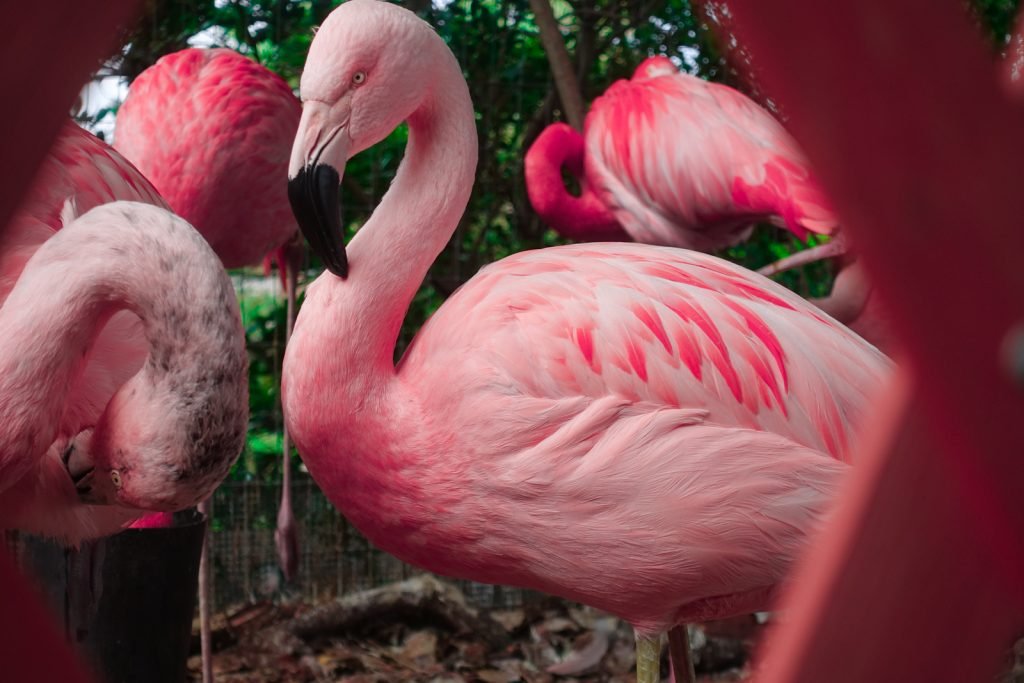
Fashion and pop culture are ultimately mysterious worlds. Lucky is the one who manages to comprehend how laws of physics and common sense work in those alien universes.
The Flamingo trend appears to be an ultimate ambassador and living proof of this intergalactic theory. How did a tacky and kitsch lawn decoration of American suburbia manage to conquer fashion podiums and design trends repeatedly decade after a decade?
In light of the upcoming seasonal acute of Flamingomania in 2021, we decided to dig deeper into the matter and try to understand how Flamingo barged into Western pop culture and where it is planning to go next.
The growth of Flamingo population.
Looking at the numerous prints and images of Flamingo on clothes, home textiles, and accessories, most of us might think it is another tribute to the pop-culture trends from the 80-s.
Indeed, the decade of kitsch make-up, massive plastic accessories, big shoulders, and flashy colors is thrilling modern designers’ minds for several years in a row. And Flamingo, one of the ultimate symbols of that trend, seems to look pretty natural and organic in the modern translation.
Today you see Flamingos everywhere – from the dollar-store junk to pages of design magazines and catwalks of hi-end fashion brands. Ask anyone, and they will find several explanations for this phenomenon.
Some might say that Flamingos are majestic and elegant. Others suspect that it is all about the pink color, and if elephants were naturally pink, Dumbo would have all chances to become a fashion icon.
There are also people who suggest that the ongoing flamingo madness is just another proof of how social media can launch and plant a trend in a matter of several hours. You can hardly find an influencer Instagram profile that does not contain at least one Flamingo-related image.
But where did it all start, and, more importantly, where is this pink cloud going?
In fact, the Flamingo phenomenon in pop culture is a storybook example of how a proper approach with just a pinch of magic can turn a symbol of bad taste into the mascot of the fierce and freedom-loving culture of the XXI century.
It is pink, it is tropical, and it is a bird! – What does it take to become a fashion icon?
Not many of us remember that Flamingos’ crusade towards Western pop culture started back in the 1950s. Almost 70 years ago, a young graphic designer with an ironically fitting name Donald Featherstone came up with an idea of a plastic pink Flamingo ornament for the Union Products Catalog 1957.
Who could have thought back then that a pair of hideous lawn decorations sold through a catalog for $2,76 will become forefathers of a vast population that will nest all over the pop culture industries in the upcoming century? Especially, considering the fact that those products have instantly become a hit among suburbia households – the commonly recognized source of lousy taste and philistinism, hardly ever associated with fashion or art.
Flamingos could have ended their days behind white fences of small-town America, but in 1972 they caught an eye of an avant-garde director John Waters and became his mascot for life as the main character of his “Pink Flamingos” breakthrough work.
Since then, the “exercise in poor taste” might have been compared to face piercing, tattoos, tattered jeans of another way of cultural rebellion. For example, primarily thanks to the film, they even managed to become kind of a mascot of the American Gay Community for a brief period of time.
But just like many of those domestic rebellion icons, Flamingos have soon enough become pretty habitual.
When Union Products have closed its plastics manufacture, Flamingos might have risked vanishing from the Western pop culture for good.
But their explosive popularity at the moment caused some indelible scars in the minds of fashion and interior designers, which helped Flamingos survive as a decorative species.
Flamingo – reborn from the fashion ashes
You might name 2015 the official second birthday of the Flamingo trend in pop culture.
Marc Jacobs` Spring Collection that year became iconic instantly, primarily due to Flamingos’ flashy and daring domination all over the clothes and accessories. Above all, that collection was one of the first statements for a long time that pink is as acceptable for menswear as any other color.
Marc Jacobs was an ultimate fashion headliner at the time. No wonder other highly-reputed brands such as Gucci, Ginchy, and Bottega Venetta have picked up the idea right away, and Flamingos populated catwalks of fashion weeks worldwide.
Why did it happen? Mainly because 2015 was the year when the fashion industry has truly felt the social pressure. Big reputed names were more and more often called archaic and unwieldy, being tagged by indie fashion lines. They needed a new and daring solution, and Flamingo seemed to bring it on its colorful wings straight from the era of rebellious originality.
Flamingos once again could have become the fashion trend that comes and goes without a trace, but for the simultaneous rise and crazy popularity of Instagram. From the place where people shared pictures of their cats and children, social media became a robust overarching marketplace and trendsetter. So when Taylor Swift, Gigi Hadid, and other influencers started posting pictures of inflatable, printed, sculptured, and embroidered Flamingos, those birds finally found their habitat.
Flamingos building a business empire
It always worked like this – people saw a celebrity wearing something, they instantly want a piece of the trend for themselves. Social media just made the process of a trend spreading almost instant. Demand emerged in a matter of several weeks. Retailers noticed the high-flight of Flamingos and reacted like well-trained snipers.
In the very same season, you simply could not enter a store without seeing several flaming-related items in clothing, textile, or décor sections. Flamingo bed sheets, curtains, dishes, and throw pillows, as well as clothes, accessories, and jewelry, are everywhere.
The commercial success of the bird is pretty understandable. Hardly can you name any other image that would look equally organic on lingerie and children’s clothing, as a theme for teenage plastic jewelry, and as a color accent in minimalistic interior designs.
And we are not talking only about affordable furnishing and mass-market retailers here. Flamingos somehow manage to pull out $200 silk scarves, $400 tote bags, and even $1,500 dresses. So those who consider today’s Flamingos another fast-fashion trend should think twice.
Flamingos appear to be an ultimately unique phenomenon in Western pop culture. Failing to become a symbol of any particular social group or movement, those birds took the most powerful industries without a fight.
You may compare them with an aging rock star – hardly can anyone imagine stable relationships with this character due to shady past and unclear future, but still, everyone wants a piece of it in their lives.
The ugly duckling of American pop culture, Flamingos, might have simply got lucky at some point. However, today we realize that if they did not exist in the fashion and décor industries today, somebody simply had to come up with this idea! They managed to exploit and use every possible way to get famous in the XX-XXI centuries – from catalogs to Avant-guard movies, from kitschy behavior to flashing on celebrities` Instagram profiles. And they undoubtfully mastered the game.
Even those who predict Flamingos’ total oblivion due to modern pop culture’s dynamic and unpredictable character should take the front row and watch how those flashy birds will find a way to fascinate future generations.
