


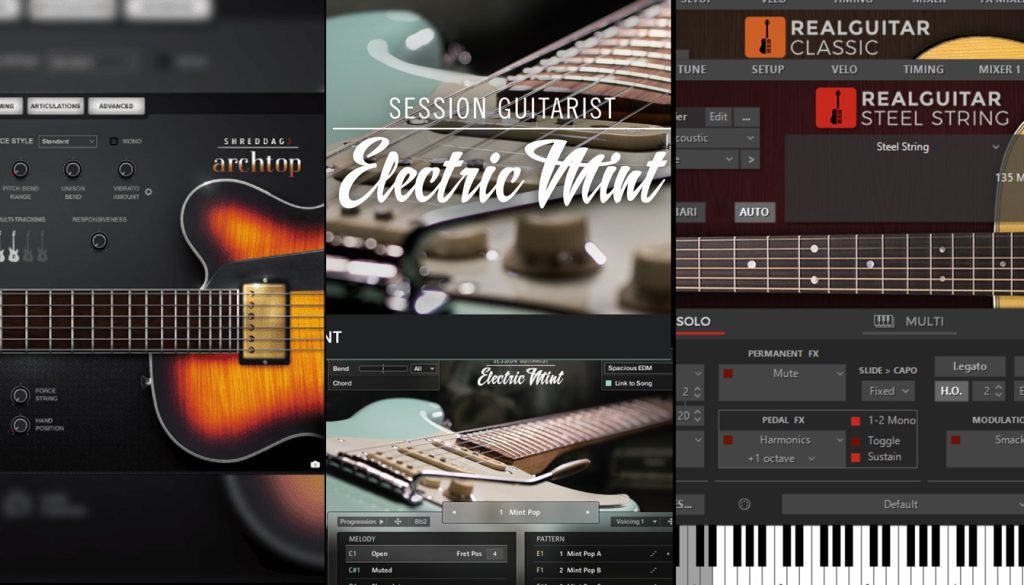
The line between a blistering live take and a meticulously programmed track has never been blurrier. In 2026, the world of virtual instruments has moved far beyond static samples, entering a new era powered by artificial intelligence. For our productions, this means access to plugins that don’t just mimic a guitar, but play like one.
We’ve been putting the most talked-about virtual guitar instruments through their paces in our studio sessions. We wanted to see which ones could genuinely generate authentic strumming patterns, articulate solos with human-like nuance, and model legendary amps with convincing accuracy. After weeks of testing, we’re ready to share our findings on the definitive AI guitar plugins of the year.
Native Instruments Session Guitarist Series
Best for: Songwriters, pop producers, and anyone needing pro-quality rhythm tracks fast.
In our testing, this series was the undisputed champion for speed and songwriting ease. Native Instruments has perfected the “virtual session musician,” and their Session Guitarist plugins are our go-to for quickly laying down ideas. We found these aren’t just sample libraries; they are AI-powered pattern players that understand chord voicings and genre conventions.
During our sessions, we simply played chords on a MIDI keyboard, and the plugin—whether it was Strummed Acoustic or an electric model like Electric Mint—generated a flawless, realistic guitar performance. The AI engine is incredibly smart, seamlessly adapting its massive vocabulary of patterns to our chord changes. The level of control is impressive; we could easily dial in fret noise, accents, and use the “doubling” feature for instant stereo width. It’s the fastest way we found to get a professional-sounding guitar part into a track.
Impact Soundworks Shreddage 3 Series
Best for: Rock and metal producers, film scorers, and meticulous sound designers.
When our projects demanded hyper-realistic electric guitars and basses, we turned to the Shreddage 3 series. What makes Shreddage an AI powerhouse, in our experience, is its sophisticated articulation mapping and performance engine (TACT 3.0). The plugin intelligently triggers different articulations—like slides, mutes, and pinch harmonics—based on playing velocity and musical context.
We were blown away by how it automated realism. Instead of manually programming every nuance, we could perform a line, and the AI would select the most logical articulations, making the performance sound incredibly human. The engine’s customizable fretting algorithms ensure that the virtual hand movements are physically plausible. For projects requiring that next level of detail, Shreddage 3 consistently delivered results that blurred the line between a sample library and a live performance.
MusicLab RealGuitar 6
Best for: Folk and acoustic artists, composers, and producers needing authentic nylon and steel-string sounds.
For that pure, acoustic sound, our team had a great experience with MusicLab’s RealGuitar 6. Its strength lies in the AI-powered “Floating Fret Position” technology, which expertly mimics how a real guitarist shifts their hand on the neck. This gave us incredibly smooth and natural-sounding chord voicings that are often a dead giveaway in other virtual guitars.
Furthermore, its sophisticated strumming engine was a highlight of our tests. We created complex and humanized rhythm parts with ease, either by using the vast library of pre-made patterns or building our own. The engine simulates the physical act of strumming, giving us fine-toothed control over the subtle variations that make an acoustic performance breathe.
Neural DSP Archetype Series
Best for: Guitarists with an audio interface and producers seeking the most accurate amp and pedal tones.
While not a guitar generator, no “we tested” list would be complete without mentioning the plugins we used to shape our tones. Neural DSP’s use of AI in amp modeling is revolutionary. Their Archetype series, featuring signature models from artists like Gojira and Cory Wong, utilizes advanced machine learning to capture every sonic detail of legendary amplifiers and pedals.
In 2024, Neural revealed they use a custom robot, TINA (Telemetric Inductive Nodal Actuator), to analyze real-world amps, removing human bias and allowing the AI to create near-perfect digital models. We ran the direct output from the other VSTs on this list through Neural DSP plugins, and the results were stunning. This combination gave us a level of tonal realism that, just a few years ago, we would have thought impossible without a physical amp.
Our Final Take
After extensive use, it’s clear the AI guitar plugins of 2026 are more than just tools; they’ve become creative collaborators in our workflow. They understand music, emulate physical performance techniques, and provide access to world-class tones on demand. While the soul of music will always come from human creativity, these intelligent plugins empowered our team to realize our vision with unprecedented speed and fidelity.

